
OCPP Interoperability
Your chargers speak OCPP. So does Faraday.
Faraday manages chargers over the Open Charge Point Protocol, the open standard the charging industry runs on. Any unit that speaks OCPP 1.6J or OCPP 2.0.1 can be managed from the same dashboard, priced by the same tariff engine, and billed through the same session ledger — whoever built it.
What speaking OCPP actually gets you
OCPP is a protocol, not a badge. These are the things Faraday does with it once a charger is connected.
Chargers introduce themselves
A charger reports its own vendor, model, serial number and firmware version when it connects. Faraday manages it on that basis, so adding a second hardware brand to a site is a procurement decision rather than a migration.
The version is negotiated, not configured
Charger and platform agree the OCPP version at connection time. The agreed version is recorded against the unit as a record of what it actually connected with — never as a setting someone has to keep correct by hand.
Nine connector states, live
Available, Preparing, Charging, SuspendedEVSE, SuspendedEV, Finishing, Reserved, Unavailable and Faulted come straight from the charger’s own status messages, tracked per connector rather than per unit.
Faults in plain English
Fifteen OCPP error codes — ground faults, over-current, connector lock failures, RFID reader failures and the rest — are rendered as readable text next to the connector that raised them, so a technician is dispatched with a reason rather than a code.
Availability you can trust
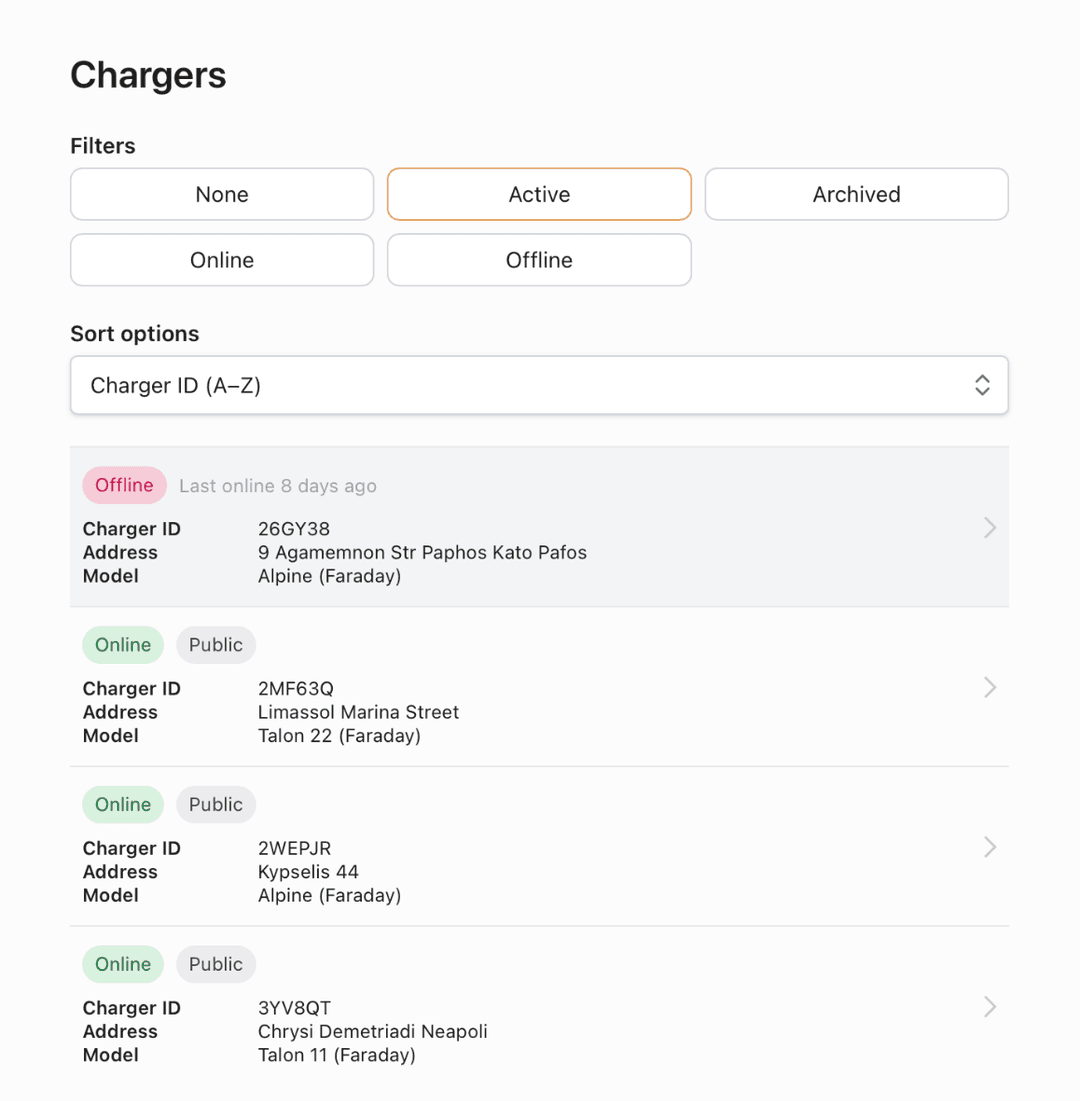
Chargers send a heartbeat every five minutes and are marked offline only after two are missed. Brief reconnects are normal on cellular and Wi-Fi sites, and the ten-minute window keeps them out of your alerts.
Every message is kept
Each OCPP call, result and error is stored with its direction, action, payload and error code. When a charger misbehaves, Faraday support reads the actual exchange instead of reconstructing it from memory.
Connection lifecycle
What happens between a charger and the platform.
OCPP runs over a persistent WebSocket connection that stays open for as long as the charger is up. This is the sequence every connected unit goes through.
The handshake
The charger opens a WebSocket and offers the OCPP versions it speaks. The platform selects one it also supports and the connection proceeds on that version. A unit offering nothing in common is refused outright rather than half-managed.
Identity on boot
The charger’s first message announces its vendor, model, serial number and firmware version. These populate the device record, so a firmware change made on site shows up without anyone editing anything.
Status per connector
Each connector reports its own state and, when something is wrong, an OCPP error code plus whatever vendor-specific detail the manufacturer chose to attach. A multi-connector unit is tracked as several independent bays, not one.
Heartbeat and grace
A heartbeat every 300 seconds keeps a unit marked online. Two missed heartbeats — 600 seconds — is what it takes to be marked offline, deliberately slower than a single dropped packet.
From message log to event trail
Notable messages are promoted into charger events — went offline, came back, connector faulted — and each event keeps a reference to the exact message that produced it. The timeline is derived from the protocol, not written alongside it.
Four ways a session starts.
Faraday records four: RFID, Pay App, Plug & Charge, and unauthenticated auto-start. How a driver is authorised changes what happens afterwards — who is billed, when, and against which tariff — and every method writes the same session record, so reporting never forks by access type.
RFID cards and fobs
A tag is checked against the cards authorised for that specific charger and comes back accepted, blocked or unknown. Cards are scoped per charger and per group, so a fleet tag need not open every bay on the network.Pay App and Plug & Charge
A QR scan starts a Pay App session that settles immediately at the charger. A Plug & Charge contract certificate authorises the vehicle itself, with no card and no phone involved.
Auto-start for private sites
Chargers can begin charging the moment a vehicle is plugged in, with no card and no app, for residential and access-controlled sites where authorisation happens at the gate rather than at the charger.Settlement follows the method
Pay App sessions settle immediately against the driver’s payment. Sessions started any other way are invoiced later or left unbilled, and that choice is recorded on the session rather than inferred from it afterwards.
OCPP questions
- What is OCPP?
- The Open Charge Point Protocol is the open standard that lets a charging station and a management platform talk to each other. It is maintained by the Open Charge Alliance and is what almost all commercial charging hardware ships with, which is what makes it possible to change platform without changing chargers.
- Do I have to buy chargers from Faraday?
- No. Faraday is a software platform and does not require you to buy its hardware. Any charger that speaks OCPP 1.6J or OCPP 2.0.1 can be managed, and the platform learns the vendor, model and firmware from the charger itself when it connects.
- Can I run more than one charger brand on the same network?
- Yes. Chargers are managed individually over the protocol, so a site can mix manufacturers, connector types, and AC and DC units. Tariffs, access rules and reporting apply across the whole network regardless of who built each unit.
- Which connector types are supported?
- Type 1, Type 2, CCS1, CCS2, CHAdeMO, IEC 60309 and Tesla, across both AC and DC. Connector type, power rating and power type are recorded per connector, so one charger can expose several connectors with different capabilities.
- What happens when a charger goes offline?
- It stops sending heartbeats and is marked offline once two consecutive intervals pass, which takes ten minutes. Brief reconnects lasting a few seconds are normal OCPP behaviour on cellular and Wi-Fi sites and do not mean a charger has stopped working.
- How are hardware faults surfaced?
- A connector reporting a fault sends an OCPP error code, which appears on that charger’s event timeline in readable form — a ground fault, an over-current, a connector lock failure — alongside any vendor-specific detail the manufacturer attached.
- Does Faraday support OCPI or roaming?
- No. Faraday’s interoperability is between chargers and the platform, over OCPP. Roaming between charging networks — a driver on one operator’s contract charging on another operator’s hardware — uses a different protocol family and is not something Faraday offers today.
Bring your own chargers.
Tell us what hardware you run and we will confirm what Faraday can do with it. If it speaks OCPP, the answer is usually everything on this page.