
Network Management
One control plane for your entire charging network.
Real-time charger status, rule-based tariff scheduling, analytics-driven recommendations, and full session transparency — managed from a single dashboard.
Everything a modern charging network needs
Our Charger Management System (CMS) connects hardware, operations, and billing into a single control plane.
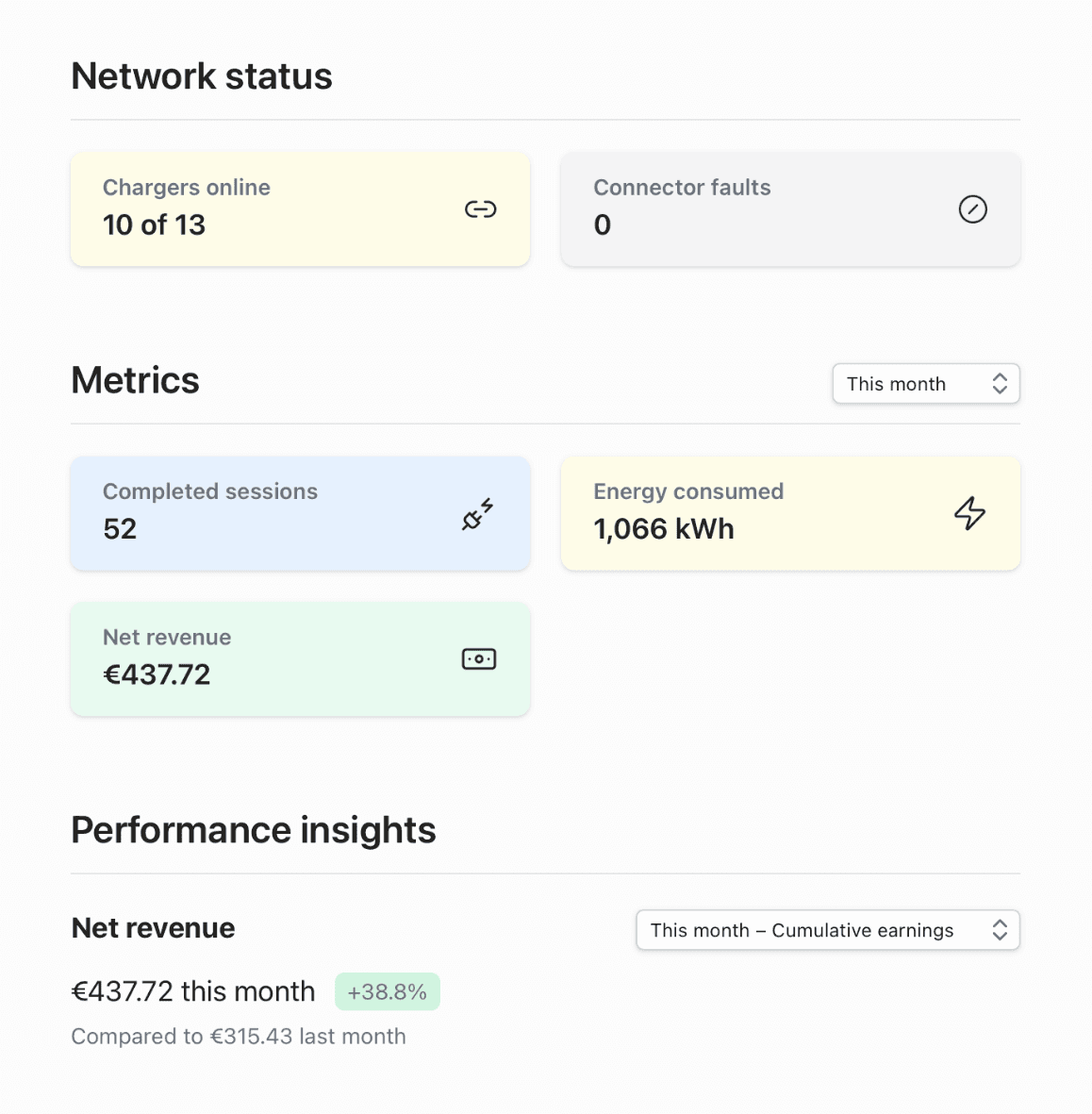
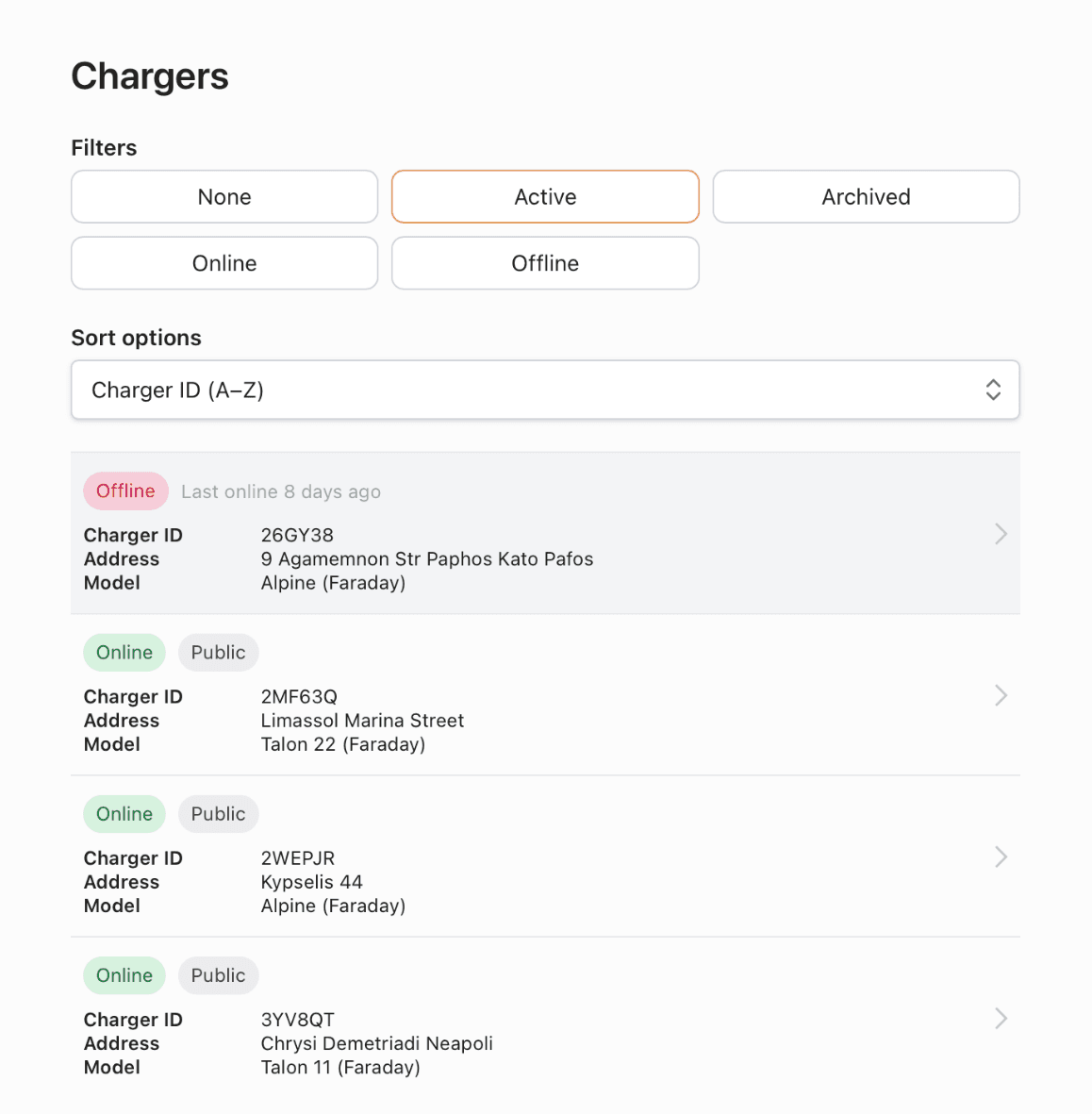
Real-time status & remote control
See charger state, active sessions, and fault codes live. Clear faults and push configuration without a truck roll.
Rule-based tariff scheduling
Configure multi-component tariffs that dispatch automatically by time of day, day of week, season, and access method — RFID, Pay App, Plug & Charge, or unauthenticated auto-start.
Analytics & recommendations
Utilization heatmaps and auto-generated recommendations that flag idle fee opportunities, underperforming chargers, and expansion signals.
ChargePass — guest sessions without friction
Share a web link that starts a charging session. No app download, no RFID card, no driver registration required.
RFID access control & groups
Assign RFID cards and fobs, manage group-scoped permissions, and control access at charger or site level for fleets and private deployments.
OCPP 1.6J & 2.0.1 interoperability
Vendor-neutral management of any charger that speaks either version. Every message exchanged with a charger is recorded, so Faraday support diagnoses faults at the protocol level instead of guessing at them.
Tariff engine
Pricing that matches how your site actually trades.
Tariffs are assembled from priced components and dispatched by rule, so one network can price a workplace, a hotel forecourt and a public bay differently without anyone changing a setting by hand.
Four priced components
Charge by energy per kWh, by time per hour, or as a flat fee per session — and add an idle-time rate per hour for vehicles that stay connected after charging finishes.
One primary rate, plus idle
Each tariff has exactly one primary method — energy, time or flat — and an optional idle-time surcharge with its own grace period, so drivers are not penalised the moment charging completes.
Per-session minimum
Set a floor so short sessions still cover their cost. Flat-fee tariffs take no minimum, because the flat fee is already the floor.
Rules dispatched by priority
A schedule holds an ordered set of rules matched on time of day, day of week, a seasonal date range, an effective-from and effective-to window, and the access method used to start the session. Anything unmatched falls back to the default tariff.
Any currency, tax inclusive or exclusive
Each tariff carries its own currency, and unit rates are held at a precision that survives tax-inclusive and tax-exclusive back-calculation — including currencies with zero or three decimal places.
274%
Network growth
Energy delivered, year over year to September 2026.
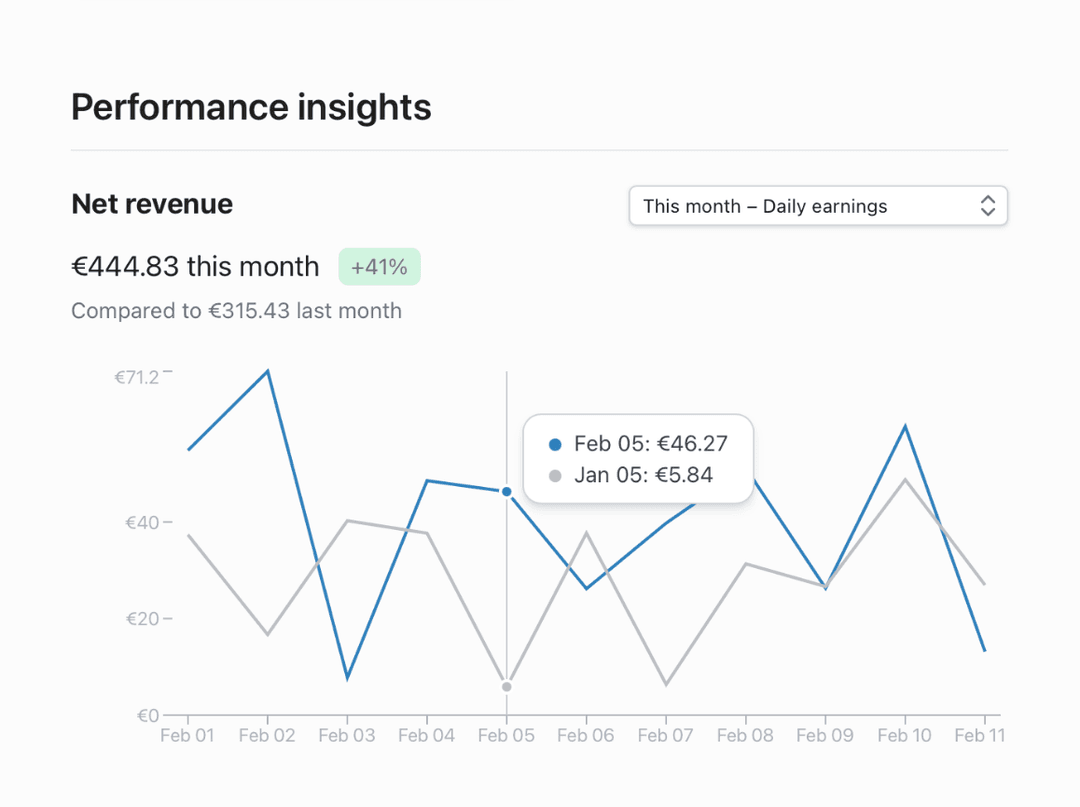
Operational insights that act on themselves.
Utilization heatmaps show demand patterns across your network. Auto-generated recommendations surface when to adjust tariffs, enforce idle fees, and plan expansion — before revenue slips.
Every session. Fully accounted.
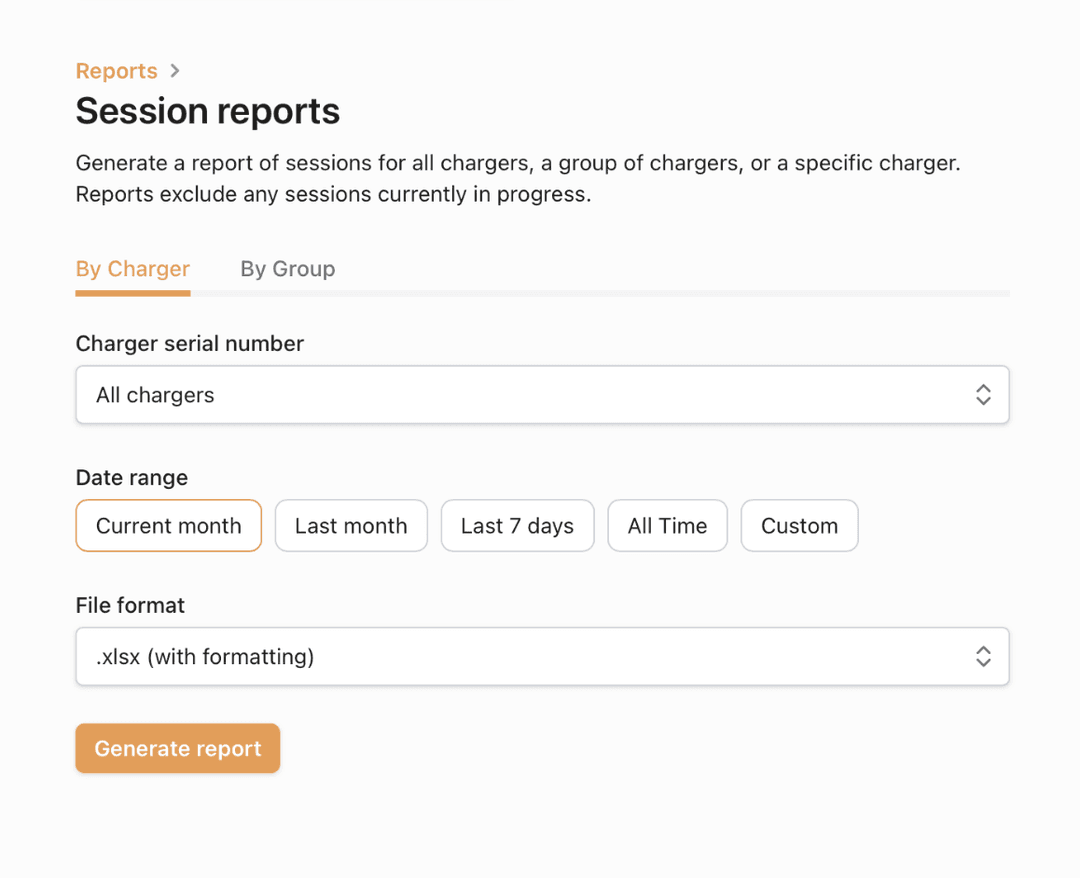
Run granular reports by charger or across entire groups with full session transparency. Track and analyze session duration, energy consumption, revenue, and platform fees — all structured for clean reconciliation and stakeholder reporting.
Every session, segmented
A session is divided into contiguous, non-overlapping periods, each typed as charging, idle or interrupted and each carrying its own energy reading and timestamps.Faults are never billed
When a charger reports itself faulted, unavailable or reserved, that period is recorded as interrupted and excluded from the bill — the bay was occupied through no fault of the driver.
Line-by-line bills
Each bill itemises its components — energy, time, idle time, flat fee, minimum fee — with quantity, unit, pre-tax amount, tax and total on every line, and records whether the card transaction was captured, refunded or disputed.Reproducible months later
The tariff and tax profile in force are snapshotted onto the session itself, so any bill can be recalculated against the rates that applied at the time rather than today's.
Network Management questions
- Which OCPP versions does Faraday support?
- Faraday manages chargers on OCPP 1.6J and OCPP 2.0.1. The version is agreed with each charger when it connects and recorded against it, so you can always see what a given unit actually connected with.
- Does Faraday work with my existing chargers?
- Yes. Faraday is vendor-neutral: a charger identifies itself when it connects, reporting its own vendor, model, serial number, and firmware version, and is managed on that basis. You are not tied to a single hardware manufacturer.
- How can drivers start a charging session?
- Sessions can be started with an RFID card or fob, a ChargePass web link that needs no app download or driver registration, a Plug & Charge contract certificate, or plug-and-play auto-start.
- How are charging tariffs configured?
- Tariffs are multi-component and rule-based. Rules are evaluated in priority order and can match on time of day, day of week, season, an effective date window, and the access method used to start the session — RFID, Pay App, Plug & Charge, or unauthenticated auto-start.
- Can I control who is allowed to charge?
- Yes. Assign RFID cards and fobs to access groups and scope permissions at charger or site level, for fleets, workplaces, and private deployments.
- How is idle time billed?
- Idle time is an optional surcharge on top of the primary rate, charged per hour once a vehicle stays connected after charging finishes. It has its own grace period, so drivers are not penalised the moment charging completes.
- What happens if a charger faults mid-session?
- That period is recorded as interrupted rather than charging or idle, and interrupted periods are never billed. The bay was occupied through no fault of the driver.
Working out whether your existing hardware fits? See how Faraday works with OCPP chargers
See Network Management in action
Turn live charger data into predictable performance and revenue.